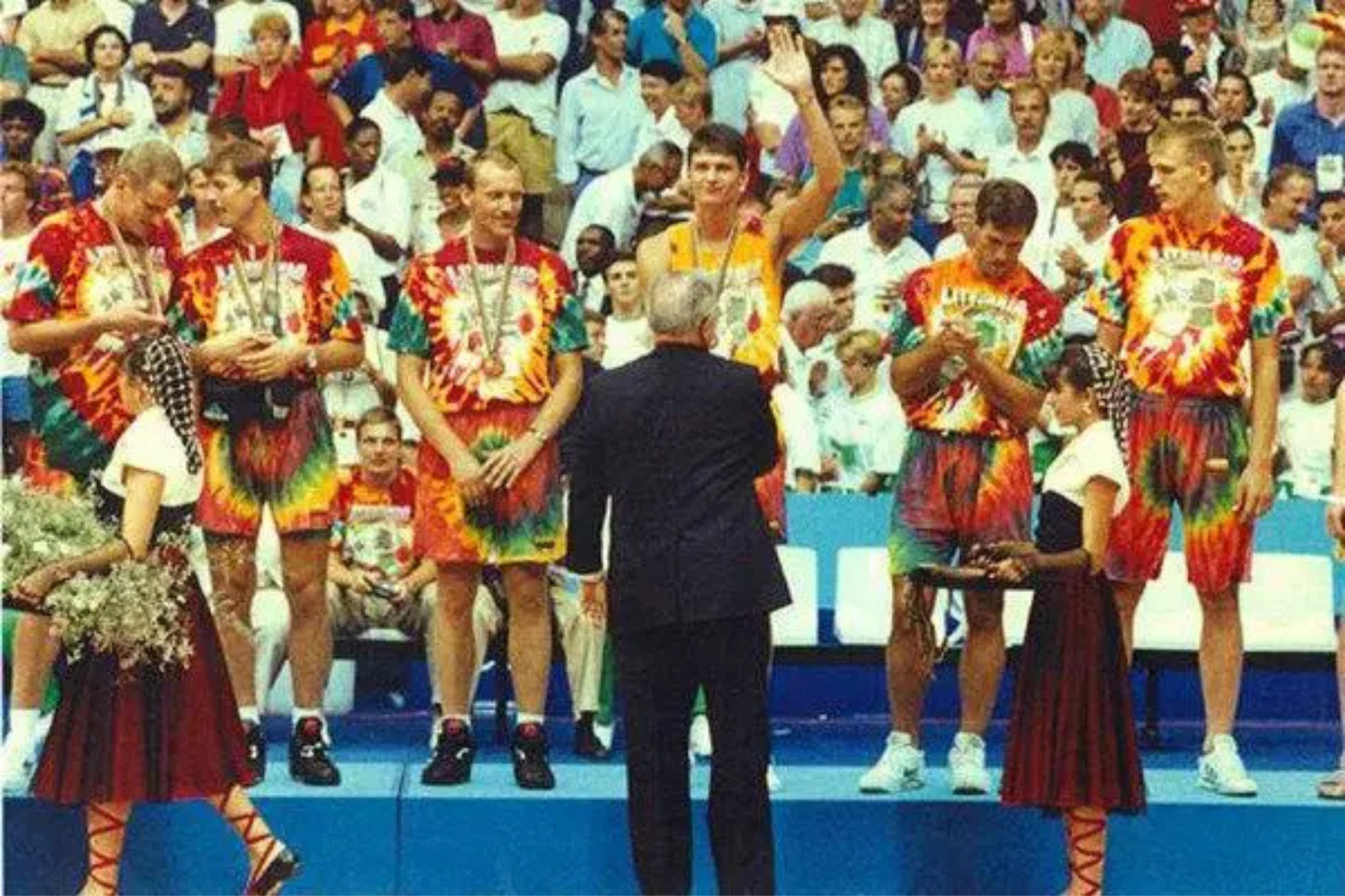

What does freedom look like? For some, it’s a flag raised high. For others, it’s the sound of a crowd cheering, not for an empire, but for a home. For Lithuania’s basketball team, freedom didn’t come from battlefields or power. It came from the court — from the echo of a basketball and the hope of playing under their own flag again.
Three Million Free from the Soviet Shadow
In 2012, a documentary called The Other Dream Team told the story that history books often miss. On paper, it’s about a small nation’s basketball team competing in the 1992 Olympics. In truth, it’s a story of quiet resilience — of how a simple game became a symbol of hope. Lithuania may be small, with just three million people, but its spirit runs deep. After fifty years under Soviet rule, the country finally reclaimed its independence in 1990. Two years later, for the first time in half a century, its basketball team stepped onto the Olympic court, not under another nation’s flag, but proudly under its own.
And that meant everything.

Latest Post: Wolfgang Borchert and the Postwar Generation: Why Youth Should Know
Leaving the NBA for Lithuania
At the time, Lithuania’s brightest stars — Arvydas Sabonis and Šarūnas Marčiulionis — had once played for the Soviet Union at the 1988 Seoul Olympics. They were promised the chance to play in the West if they won gold. But for them, it was never just about basketball — it was about the longing to live, and play, in freedom.
Marčiulionis later recalled how athletes were often victims of the harshness of the communist regime. There were times when they had to hide from KGB (Komitet Gosudarstvennoy Bezopasnosti) agents, protecting not only their dreams but their very lives. Yet even in those moments of fear, they shared a quiet vision: to use their talent not for an empire, but for their homeland.
Their victory over Yugoslavia, 76–63, opened the door for Sabonis and Marčiulionis to join the NBA. Marčiulionis would go on to become the first Soviet player ever to enter the league — though, to him, that label never felt right.
While playing in America, many assumed he was Russian — a citizen of the communist giant. But each time he heard that, he gently corrected them: “I’m Lithuanian.”
And when news reached them that Lithuania had finally regained its independence — that their country would once again compete under its own name at the 1992 Olympics — both men made a choice. They stepped away from the NBA, leaving behind fame and comfort, to help rebuild a national team for a nation reborn after fifty years of silence.
“The Other Dream Team”

Money was a rare luxury for the Lithuanian team. While American players thrived with generous salaries and sponsorships, athletes under the Soviet system earned barely $100 a month — a small sum that spoke volumes about the limits of their world.
Then came an unlikely twist. The American rock band The Grateful Dead became aware of Lithuania’s struggle. They sent a check, along with tie-dye jerseys splashed in yellow, green, and red — the colors of Lithuania’s flag featuring a skeleton dunking a basketball.
After decades of Soviet gray, the team suddenly looked like fireworks. They wore those shirts everywhere, at practice, at night, even to bed. They weren’t just uniforms; they were symbols of rebirth.
They reached the semifinals to face the mighty U.S. team — a constellation of legends. The game ended 127–76, a loss on paper, but not in spirit. For a nation that had only just reclaimed its flag, even standing on that court was a victory in itself.
Sometimes bronze is sweeter than gold.
Because their fight wasn’t over. Lithuania’s final match would be against Russia — the very nation that had once ruled them. It was more than a game; it was history in motion, a battle of pride and memory. Like David facing Goliath, Lithuania played with fire in its heart and freedom in its hands. When the buzzer sounded, the score read 82–78 — Lithuania triumphant.
It wasn’t just a win; it was a declaration. To the world, and to their former oppressors, Lithuania had spoken — they were free, and they would never be silent again.
Previous Posts




Leave a Reply